Start here: coating vs. treatment

Most products sit on your roof. This one soaks in.

Most sealants — silicone, acrylic, soybean-oil blends — form a thin film that sits on top of the shingle, like a layer of paint or wax. It can look good for a season or two, then UV light, foot traffic, and weather cause it to crack, yellow, or flake off.

GoNano's NuRoof particles are measured in nanometers — thousands of times smaller than a human hair. That's small enough to actually work down into the asphalt's own microscopic pore structure and bond there, instead of coating over it.

💡

Think of an old wooden deck. You can paint over it — which looks fine until the paint peels — or you can use a penetrating wood oil that soaks into the grain and protects it from the inside. NuRoof is the second kind of product, applied to your shingles instead of your deck.
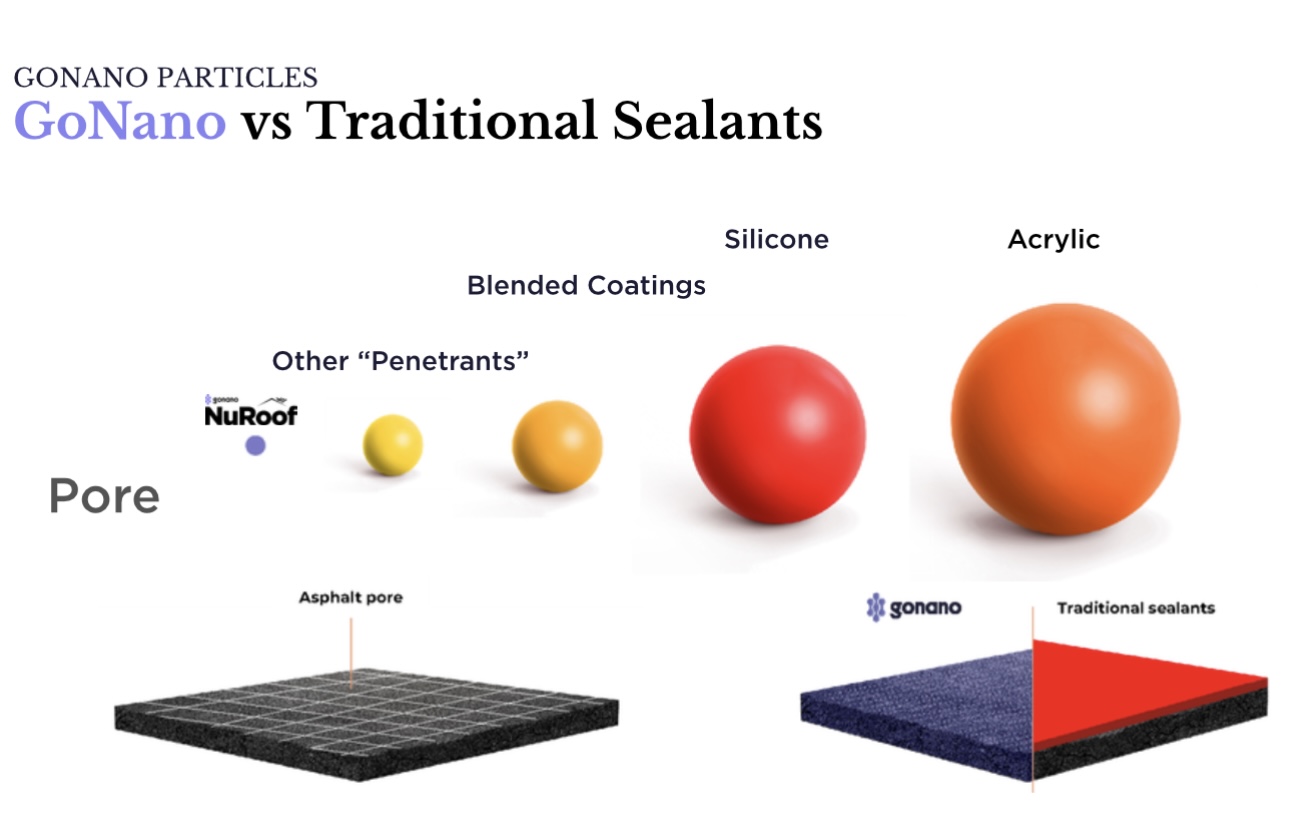
GoNano nanoparticle size compared to traditional sealants, and asphalt pore penetration diagram
Why size is the whole story

Bigger molecules physically can't get in.

Every asphalt shingle is covered in microscopic pores — too small to see, but real. Traditional acrylic and silicone sealant molecules are simply too large to fit into those pores. They pool on top instead, the way a bead of water sits on a freshly waxed car hood instead of soaking into the paint.

NuRoof's particles are small enough to pass into the pore itself and bond there chemically, which is the mechanical reason it can restore flexibility and reduce granule loss from the inside — instead of just changing how the surface looks.

💡

It's the same reason a beach ball can't fit through a keyhole but sand can. Traditional sealants are the beach ball. NuRoof's nano-particles are small enough to be the sand.
How it works, step by step

Three things happen when NuRoof is applied.

This is the actual mechanical process — not marketing language, just what physically happens to the shingle.

1

Penetrates

The treatment is sprayed on evenly across the roof and immediately begins working its way into the asphalt through its pore structure.

  • Nano-scale particles, far smaller than a coating molecule
  • Reaches into the shingle's pore structure, not just the surface
  • No film left sitting on top once it's absorbed
💡

Like a dry sponge soaking up water — it doesn't just get wet on top, it pulls the liquid all the way through itself.

2

Reinforces

Once inside, the treatment bonds chemically with the asphalt and the mineral granules embedded in it.

  • Helps glue granules in place, slowing granule loss
  • Restores flexibility to asphalt that's gone brittle with age
  • Improves resistance to hail impact and wind uplift
💡

Similar to how a conditioner works into leather to keep it supple instead of cracking — the material itself becomes more flexible, not just shinier.

3

Rejuvenates

Over the following weeks, the shingle's condition visibly and measurably improves as the treatment fully cures.

  • Restores a more like-new appearance and original color
  • Sheds water and resists algae or staining growth
  • Extends usable roof life by years, not months
💡

Think of it less like a fresh coat of paint and more like your shingles getting their original oils back — the way leather boots look and perform better after being properly reconditioned instead of just polished.

See it in action

Watch how NuRoof actually works.

A quick look at the treatment itself — what it does to the shingle and why it holds up.

Video thumbnail — click to watch on YouTube Watch on YouTube →
Understanding the ratings

What "Class 1 to Class 4" actually means.

You'll see impact-resistance classes mentioned a lot on this site. Here's what they actually are, in plain terms, so the number means something instead of just sounding impressive.

Roofing impact resistance is measured with a standardized test: steel balls of increasing size are dropped onto a shingle from a set height to simulate hail, and the shingle is rated by the largest impact it survives without cracking or splitting. Class 1 is the lowest rating; Class 4 is the highest and toughest.

Class 1Entry-level. Cracks under smaller, slower hail impacts.
Class 2Modest improvement. Still vulnerable to moderate hail.
Class 3Solid mid-tier protection against most common hail sizes.
Class 4Top tier. Survives the largest standardized impact test without cracking.

A single coat of NuRoof typically lifts a roof from Class 1 to Class 3, or Class 2 to Class 4. Our double-coat system is capable of taking a Class 1 roof all the way to Class 4. In plain terms: the difference between a roof that dents and cracks under hail and one that shrugs it off. Many home insurance providers also recognize impact-resistant roofing with policy benefits — it's worth asking yours what a higher class could mean for your premium.

Bottom line

Here's what all that science actually buys you.

Forget the chemistry for a second. This is the payoff:

🛡️

Hail stops being a threat

A higher impact class means the next storm is a non-event, not a claim.

💰

You keep your money

A treatment runs a fraction of a reroof — that difference goes back in your pocket.

🏠

Your roof looks the way it should

No curling, no streaking, no patchy discoloration.

✅

It's in writing, not a handshake

A real warranty and real technical data sheets back the job.

Is this too good to be true?

Fair question. Here's how we'd answer it.

We'd be skeptical too if a stranger told us a spray-on treatment could add a decade or two to a roof. Here's what we'd point to instead of just asking you to take our word for it:

It's not paint

NuRoof isn't a cosmetic coating — it's a molecular treatment that bonds into the asphalt, which is why it doesn't peel like a surface sealant.

Published data sheets

GoNano publishes technical data sheets for every product with specific, product-by-product performance figures — not vague marketing claims.

It won't be right for every roof

We turn down jobs where the roof deck is compromised. A treatment that "works on anything" is exactly what you should be skeptical of.

Ask us anything

Bring your questions to the assessment. We'd rather explain the science in person than dodge it.

Want to see the technical data sheets for yourself?

Ask Us for the Specs